
The Sabre Story: Fifty Years of Maine Boatbuilding in Raymond and Rockland
Maine-built sail and power, from the Sabre 28 to today's express cruisers...
Published
The Sabre Story: Fifty Years of Maine Boatbuilding in Raymond and Rockland
If you shop Casco Bay and the New England Downeast market long enough, Sabre keeps turning up—not only as a modern Salon Express on a broker’s dock, but as a teak-finished sailboat from the 1970s or an older Sabreline fast trawler with that unmistakable Maine joinery. The brand sits in the same shopping orbit as Hinckley, Back Cove, Holland, Fortier, and C.W. Hood: Maine-built boats that trade on craftsmanship more than flash. This is the company history behind that reputation, drawn from primary and trade sources rather than brochure gloss.
Founding: Raymond, 1970
Roger Hewson came out of Montreal with a construction business and a side habit of designing boats. In the 1960s he built a small run of racing scows—long and narrow enough that he named them for a sabre, the Canadian spelling—before deciding the real work was fiberglass production sailboats he could build in volume without giving up yacht-level finish. He sold the construction company, and in 1970 he and his wife, Charlie, moved to Raymond, Maine, where Charlie had family, and put up a 4,000-square-foot shop.
That Lakes Region setting is why you still see both Raymond and South Casco attached to the brand. The plant’s longtime home is Raymond—today 12 Hawthorne Road—while South Casco appears in older mail and press addresses for the same Sebago-area operation. The official company story and Maine press both treat Raymond as the founding and manufacturing place.
Hull #1 of the Sabre 28 debuted at the 1971 Newport (Rhode Island) Boat Show. It was unfinished enough that some accounts note the incomplete presentation, but the boat still landed: standing headroom near six feet, berths for a family crew, and a handcrafted teak interior that felt larger than the LOA. Over roughly fifteen years Sabre built 588 Sabre 28s. In 2003 the model entered the American Sailboat Hall of Fame. Those numbers and the Hall of Fame induction are repeatedly confirmed in Maine Boats, Homes & Harbors, Soundings, and Sabre’s own memorials to Hewson.
Founding “partners” in the modern corporate sense came later. Early Sabre was Hewson’s yard—Roger as designer-builder, Charlie in the move that put the shop on family land—with a small crew. The investor-owners most associated with the company’s survival, Ed Miller and Daniel Zilkha, arrived in the early 1990s crisis, not at the 1970 launch.
The sail line: from the 28 to Jim Taylor
After the 28, Hewson and the Sabre design team stacked a deliberate cruiser-racer catalog. According to Sailboatdata’s builder record and contemporary company timelines:
- Sabre 34 (from 1976), with later Mark II and aft-cabin variants
- Sabre 30 series (from 1979)
- Sabre 38 (1981) and 38 Mark II (from 1988)
- Sabre 32 and 36 in the mid-1980s
- Sabre 42 (late 1980s), evolving into the 425
In the 1980s, Sailing World ranked the Sabre 34, 38, and 42 first in class—another detail Maine Boats cites in its fiftieth-anniversary piece. The boats were never the cheapest production fiberglass on the dock. They sold on laminate quality, secondary bonding, and furniture-grade woodwork that held value on the pre-owned market.
After the early-1990s ownership change, day-to-day design responsibility shifted. Marblehead naval architect Jim Taylor had already helped Hewson on keels and rudders; in 1992 Hewson asked him to lead a new 36-footer. That became the Sabre 362, followed by the 402, 452, 426, 386, the Spirit weekender, and a late refresh as the 456. Taylor’s site records six Cruising World / Sailing World Boat of the Year awards across that collaboration, plus Sail Magazine recognition for the 426. Hull shapes got longer waterlines and broader sterns; the joinery stayed Sabre.
Sail production did not end overnight. Company and industry records put the wind-down around 2012–2013 as power volume took the shop’s capacity. Sailboatdata notes an end “as of 2012,” with the possibility of a sail revival if the market demanded it; Maine Boats dates the last Sabre sailboat to 2013. Either way, new Sabres today are motor yachts—while thousands of Sabre sailboats remain active on the East Coast brokerage lists.
Into power: Sabreline, then Sabre express cruisers
By the late 1980s, dealers and owners were telling Hewson that sail customers were aging into power. In 1988–1989 Sabre answered with the Sabre 36 “Fast Trawler”—marketed under the Sabreline name as a tri-cabin motoryacht that kept trawler spaciousness on a modified-V hull that could cruise far above classic displacement speeds. Sources differ slightly on whether you date the design to 1988 (Hewson’s design year in Maine Boats) or the market debut to 1989 (Soundings, Boston Yacht Sales, Sabreline brochures); both are consistent with a late-’80s launch.
Soundings’ used-boat profile of the Sabreline 36 sketches the early power tree: the 34 Flybridge Sedan (1990), Sabreline 43 and 47 aft-cabin motoryachts (mid-1990s), and the Sabreline 36 Express (1996), which helped popularize lobster-boat Downeast lines in the recreational market. Company brochures from the Sabreline era describe deep-V hulls aimed at roughly 25-knot cruise and 30-knot top ends as the line evolved past the first fast-trawler shapes.
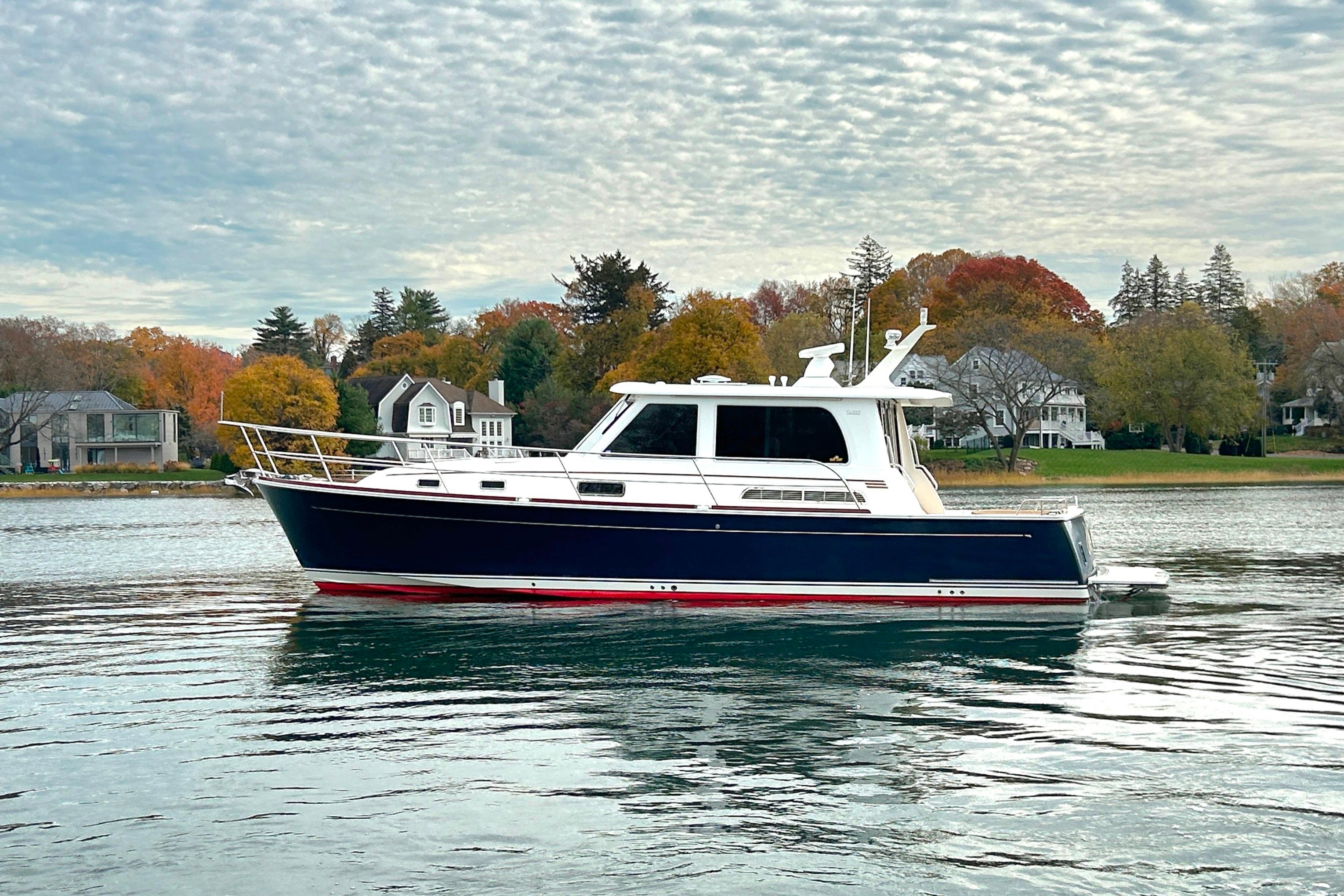
Over time the “Sabreline” badge gave way to boats simply badged Sabre, sold as Salon Express and Fly Bridge models. The architectural idea stayed related: Downeast profile, enclosed or protected helm deck on the Salon Express, serious woodwork, and performance hulls rather than pure displacement trawlers. Kevin Burns, VP of Product Development and Design since joining in 2006 (Landing School; prior Setzer Design Group), has framed the modern brief as “informed simplicity”—boats first, with Downeast appeal that is allowed to move when a better boat results. That language is on Sabre’s About page.
The 1991 crisis and the Miller–Zilkha ownership
The power pivot collided with what Hewson later called a “perfect storm”: the early-1990s recession, the federal luxury tax on yachts, and the failure of the Bank of New England, which cut Sabre’s credit. Boatbuilding stopped for about three months. Ed Miller—a Sabre owner with a summer place near the yard, and then president of Federal Express’s Caribbean and South America division—stepped in as investor. He brought in neighbor Daniel Zilkha, an investment banker (Soditic) and founder of Art & Auction, who had Maine ties through his wife’s family, to run day-to-day operations.
Down East Magazine and Maine Boats both tell that rescue story in detail. Zilkha had never owned a boat. He stayed for decades anyway. Miller remains associated with the company as vice chairman (Sabre’s leadership page still lists him that way); Zilkha is chairman after a long run as CEO of Sabre, Back Cove, and North End Composites.
Bentley Collins joined sales and marketing in 1993 and helped rebuild the dealer network around power. The company’s own later narrative—and Collins’ interviews—emphasize continuous new-model development through downturns, including the 2007–2010 recession, when Sabre kept R&D funded and introduced models such as the Sabre 48 that carried the brand through the recovery.
North End Composites, Rockland, and Back Cove
In the mid-1990s Sabre acquired North End Marine of Rockland, a mold and production fiberglass shop. Sources cite 1994 (Sailboatdata) or 1995 (Maine Boats); either way the plant was renamed North End Composites and became the composites home for larger Sabre hulls and decks.
In 2003, Sabre’s dealers pushed for a smaller, simpler Downeast cruiser—single diesel, lobster-boat manners, lower price point than the twin-engine Sabreline/Sabre range. That became Back Cove Yachts, starting with the Back Cove 29 and growing into its own Rockland-built brand. Back Cove’s About page still calls itself a “proud sister brand of Sabre Yachts since 2003.” Shared ownership and leadership (Zilkha/Miller ownership era; Aaron Crawford as CEO across the group; Kevin Burns on design for both) do not mean identical boats: Back Cove skews single-engine practical elegance in roughly the mid-30s to low-40s; Sabre builds larger twin-engine express and flybridge cruisers.
Together, Sabre and Back Cove are routinely described as Maine’s largest recreational boatbuilding company—hundreds of associates between Raymond and Rockland. Exact headcount figures in press pieces vary by year (300-plus is a recent company figure; older anniversary coverage cited 350-plus).
Design philosophy and how the boats are built
Sabre’s motto—“Crafted in the Maine Tradition”—is more than tagline. The About page describes a “Boat Parent” following each hull, multi-stage inspections (including a late “Gold Inspection”), and resin-infusion / VIP construction on current models. Performance claims for the modern range are specific: efficient at trawler-ish 8–10 knots, typical cruise near 27 knots, top speeds around 30 knots depending on model and load, on deep-V hulls with spray rails and chines meant to stay dry when Casco Bay kicks up.
That mix—workboat Downeast DNA plus yacht finish and contemporary systems (pod drives, joystick docking, networked boat systems)—is why pre-owned shoppers cross-shop Sabre against Hinckley picnic and Downeast models, Back Cove singles, and smaller custom Maine yards. Sabre is usually the enclosed-express / longer-weekend boat in that set, not the open picnic dayboat.
Recent history through 2025–2026
As of Sabre’s current public materials, leadership is:
- Daniel Zilkha, Chairman (longtime CEO; stepped back from that role)
- Ed Miller, Vice Chairman
- Aaron Crawford, President & CEO (Landing School; prior Sparkman & Stephens, Carroll Marine, Outerlimits)—Maine Boats reported the CEO handoff from Zilkha around the company’s 50th-anniversary period
- Kevin Burns, VP Design & Product Development
The current Sabre power lineup, per sabreyachts.com, centers on Salon Express models including the 38, 43, 45, 51, and 58 (with flybridge variations also part of the broader recent range). The company continues to show at major East Coast boat shows; 2026 show listings on the site include Miami and Palm Beach dates and the international debut framing for the Sabre 51 Salon Express. Builds remain in Maine—Raymond for Sabre assembly historically emphasized in dealer write-ups, Rockland/North End for major composites and the Back Cove plant.
Roger Hewson’s death was marked by Sabre and by Soundings; the company memorial stresses that every Sabre from hull #001 onward was meant to meet the standard he set. Ed Miller, notably, is still listed as owning a 2005 Sabre 426 sailboat—an emblem of how the sail DNA never fully left the ownership culture even after power took the production floor.
Where Sabre fits a pre-owned Downeast shopper
On the brokerage market, “Sabre” can mean three different shopping problems:
- 1. Classic Sabre sailboats (28 through the Taylor-era 40s)—performance cruisers with Maine joinery, often well kept, priced as quality fiberglass rather than project boats when surveyed carefully.
- 2. Sabreline-era power—fast trawlers, sedans, early Express models—that read as Downeast/express ancestors and still turn heads in Chesapeake and New England harbors.
- 3. Modern Sabre Salon Express / Fly Bridge—larger twin-engine Maine express cruisers that sit above Back Cove in size and systems complexity, and beside Hinckley in the “serious Maine power” conversation without being the same product.
For Teak & Beam readers hunting a pre-owned boat for Casco Bay weekends and New England coastwise trips, Sabre is less a picnic-boat substitute than the next size up: enclosed helm, real overnighting, and a build culture that started with a 28-foot sailboat people still race and cruise fifty years on. If the survey and systems history check out, that continuity is what you are buying.
Sources worth keeping open
- Sabre Yachts — About / leadership / design philosophy
- Maine Boats, Homes & Harbors — “Sabre at 50”
- Down East — “Full Speed Ahead”
- Sailboatdata — Sabre builder history and model list
- Jim Taylor Yacht Designs — Sabre collaboration
- Back Cove Yachts — sister-brand history
- Soundings — Sabreline 36 used-boat / early power timeline
- Boston Yacht Sales — Sabre history overview