
The C.W. Hood story: Marblehead Wasques and the soft-top dayboat
Who builds them, why the Wasque 26 still turns heads, and what to know when a pre-owned Hood shows up on the brokerage list.
Published Updated
The C.W. Hood story: Marblehead Wasques and the soft-top dayboat
In 1995, behind Little Harbor in Rhode Island, a fiberglass hull mold sat in a field with scrap paint on it. Chris Hood knew the shape. He bought the mold from his uncle for a hundred dollars, hauled it to the shop in Bristol, and put a Wasque back into production.
That is the C.W. Hood story in one scene. Everything else — Marblehead, Vineyard Yachts, the soft-top dayboats still turning up on brokerage lists — hangs off that mold.
Marblehead, before the mold
Chris Hood grew up in Marblehead, which means he grew up around serious boats and people who argued about them. He restored the family sailboat young. He designed and built a small tender he called the Ocean 1. With his friend Chris Stirling — another boatbuilder — he turned that itch into a yard.

There isn’t a neat founding-year plaque for C.W. Hood Yachts. There’s a better trail: composite jobs, engineering work, and whatever kept the shop moving. The early business wasn’t glamorous.
Chris also had one hell of a teacher nearby. His uncle was Ted Hood — America’s Cup sailor, sailmaker, and the yacht designer behind Little Harbor. Young C.W. Hood worked in that orbit. You don’t spend time around Ted’s complex and then shrug when a good hull mold turns up in the weeds.

By the mid-1990s the yard was ready for finished boats of its own. Then they found the Wasque.
Where the Wasque came from
Pronounce it WAY-squee. The name is from Wasque Point on the southeast corner of Martha’s Vineyard — a fishing ground, from an Algonquin root the builder glossed as “the ending.”
In 1969, David Thompson and partners opened Vineyard Yachts on the island and put a Wasque 32 into fiberglass: a fishing boat with Maine lobster-boat conversation in the hull. Around 1970 they asked the John Alden office in Boston for a smaller sister. Out came the Wasque 26 — Clifford Swaine and George Welsh show up in the design-office attributions — and later a 21.
Soundings and yard accounts put Vineyard production in the dozens across those three sizes over roughly sixteen years. Well over eighty island-built Wasques before Thompson retired and closed the shop in 1985.
Then the molds scattered. The 32 mold headed west for a California builder and died in a trucking accident in Arizona. The 26 mold bounced around New England for a decade — until it landed in that Rhode Island field, spray-painted for the scrap heap, behind Little Harbor.
A hundred dollars and a borrowed boat
Phil Deschamps of Nauset Marine identified the mold. Hood bought it from Ted for $100 and dragged it to C.W. Hood in Bristol.
There was only one problem: they weren’t entirely sure how the original boat had been built.
So they parked an original 1970s Wasque beside a new hull and reverse-engineered the construction. Hood redesigned the boat for the Picnic Boat era — family dayboat manners on Vineyard fishing-boat bones — and took the first order. With help from David Thompson, he also locked down the Wasque name rights.
Soundings puts roughly forty-five Hood-built Wasque 26s on the water since that restart. Combined Vineyard and Hood 26 production is often cited around the mid-seventies. Not a flood. Enough that you still meet them on Casco Bay, in Marblehead, and on a Monday brokerage email when someone finally lets one go.
What the boat actually is
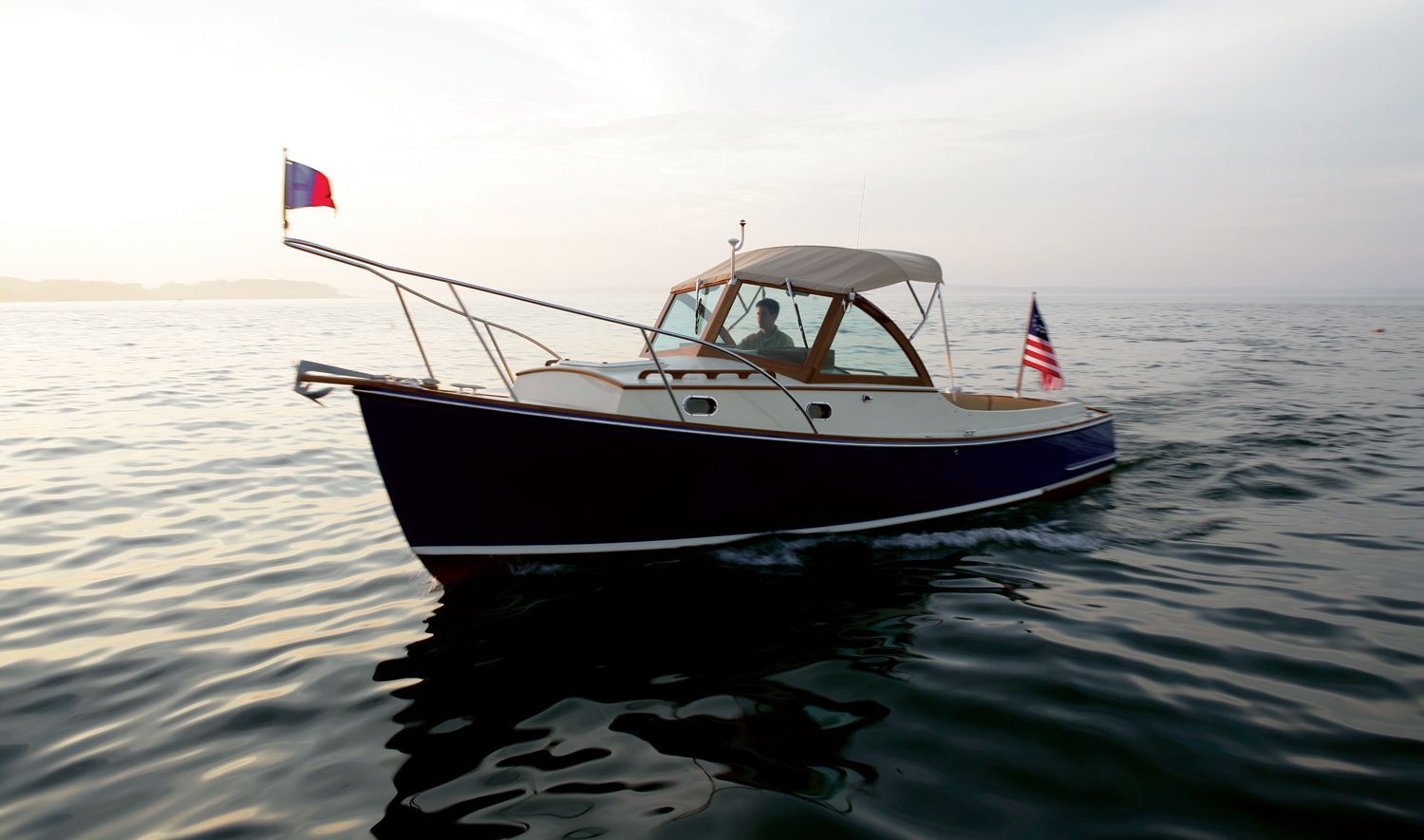
A Wasque 26 is a soft-top Downeast dayboat: low house, teak windshield frames, proud sheer, social cockpit. Underneath the picnic manners sit bass-boat / Vineyard fishboat roots — semi-round chine, keel, protected rudder, single diesel, systems you can understand without a seminar.
On the modern Hood 26, the engine moved aft for more cockpit. Easy twenty-knot cruise on a current Yanmar install is the yard’s pitch. It feels like a pocket Downeast yacht, not a mid-thirties jet program.
Restarting a true 32 without a hull mold proved too expensive, so Hood finished a Jarvis Newman / Royal Lowell Downeast as the Wasque 30 in 1999. Later Marblehead sisterships included the 29 and 33. The yard also finished other Hood power and sail work, took on Jarvis Newman itself, and still supports the Wasque 26 Classic from 3 Beacon Street in Marblehead — Chris’s hometown harbor, a few minutes from where he learned to sail.

If you’re shopping one
Owners hold Wasques. When one hits YachtWorld it is usually a Northeast or Marblehead listing, not a warehouse of inventory. C.W. Hood’s own brokerage desk still carries them beside the new builds. Florida winters, Mid-Atlantic slips, and the occasional Great Lakes or West Coast inquiry show up when someone wants New England manners elsewhere.
Ask which generation you’re looking at. Vineyard-era boats (pre-1985) and Hood-era boats (1995 on) share lines; engines, systems, and finish details do not. Confirm repower history in writing — older Perkins or gas installs versus modern Yanmars change the survey and the insurance conversation. Teak windshields and canvas are the cosmetic bill; deferred varnish is not free. And be honest about size: a 26 is a dayboat and a short overnighter. If you need mid-thirties cabin volume, buy that LOA — don’t talk yourself into a substitute.
The quiet plus: the Marblehead builder still knows the boats. That matters more than a brochure line when something breaks in October.
Decades after Ocean 1, the Wasque mold, and the first C.W. Hood builds, Hood hasn’t gone very far. The company is still in Marblehead, at 3 Beacon Street, a few minutes from the harbor where Chris Hood learned to sail.