
Holland Boats, the Making of a Coastal Classic
From the little 14 to the defining 32 and the roomier 38, Holland’s appeal begins with the working waterfront—and leaves plenty of room for pleasure.
Published Updated
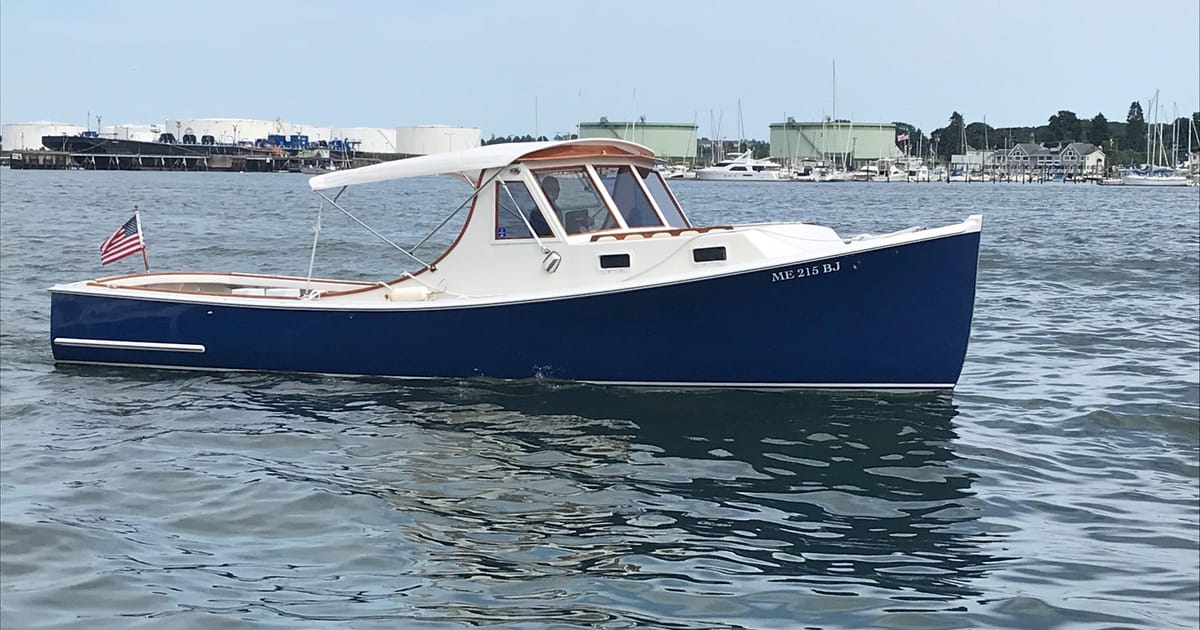
Holland Boats, the Making of a Coastal Classic
Look at the cockpit of a simply finished Holland 32 and consider how much possibility there is in an open piece of deck. A fisherman sees room to work. A family sees somewhere to put a pair of folding chairs, a cooler, and the dog. Someone with an island camp sees space for all the awkward things that need to get there.
That flexibility helps explain the Holland’s appeal. The pleasure comes partly from having a boat that leaves you free to decide what to do with it.
For those of us drawn to Downeast boats, Holland offers something especially compelling: a close connection between the shape we admire and the work that shaped it. The familiar family—the 14-foot skiff, the signature 32, and the larger 38—carries that connection across very different scales of boating. Together, they make a persuasive argument for keeping usefulness at the center of good design.
Glenn Holland came to that argument through experience. In 1972, while still serving in the Coast Guard, he brought a Repco 30 hull to Belfast to finish. More orders followed. By the middle of the decade, he was developing his own boat, taking a carved half-model and drawings to Royal Lowell. The process joined Holland’s ideas about a working boat with one of Maine’s most consequential design traditions. (Fishermen’s Voice)
Lowell was the grandson of Will Frost, whose boats helped establish the Jonesport–Beals Island tradition. Frost’s reputation embraced fishing boats, fast rumrunners, and an enduring interest in getting useful speed from a hull. That family connection puts Holland within a much longer conversation about how a Maine boat should move through the water. (Maine Boats, Homes & Harbors)
There is a temptation to treat a lineage like this as a certificate of authenticity. Its real value is more interesting: knowledge being passed along, questioned, and adjusted. Holland’s boats emerged from that process of adaptation. Their traditional appearance contains a history of people trying to make a boat work better.
The 32 tells the story particularly well. After the mold for Holland’s earlier 30-footer was lost in a fire, the replacement gained roughly two feet. Production of the 32 began in 1979. Its high bow, flare forward, and inward-curving stern gave it the recognizable profile that remains central to Holland’s identity. (Soundings)
To my eye, the 32 is where the Holland idea comes into its clearest focus. There is enough boat to suggest a useful day along the coast, with proportions that keep the hull visually in charge. A modest house and an open cockpit allow the sweep of the boat to do most of the talking. It is easy to understand why an owner might want to preserve that balance when fitting one out for recreation.
Then there is Red Baron, the Holland 32 that gave the family a distinctly competitive personality. Hull number 11 made her racing debut at Jonesport on July 4, 1981, and became a celebrated presence in Maine lobster boat racing. (Soundings)
The racing adds something valuable to the Holland story. It reminds us that traditional boatbuilding has always had room for impatience: another engine experiment, another adjustment, another attempt to go faster. The people responsible for these graceful shapes could also be enthusiastic hot-rodders. That appetite for improvement is part of the inheritance, too.
The 38 gives the family a broader canvas. Glenn developed its drawings, and Royal’s son Billy Lowell built the plug, continuing the connection between the two families. With a beam of 12 feet 10 inches, it offers more scope for working space or accommodations. (Fishermen’s Voice)
The interesting question with a larger Holland is how to use that room while retaining the visual ease that makes the boat attractive. Extra accommodations can make longer trips more comfortable. An open working deck can serve an entirely different owner. The hull provides a starting point, and the finishing decisions give each boat much of its individual character.
At the other end of the family, the little 14 brings the Holland name to the scale of a skiff. A look at the yard’s Holland 14 walkaround is a reminder that the family includes boats for a very different kind of day. The 14 matters because a coastal boatbuilding tradition needs room for small, everyday boats. A harbor run or an afternoon close to home can be the whole point of owning one. (Holland’s Boat Shop)
The custom 35 adds another dimension. After Jonesport fisherman Stevie Carver lost his Holland 32 to fire in 2016, the yard built his replacement, Another Dirls, by shortening and reshaping a 38-foot hull. Glenn’s grandson Gavin contributed to the work. (Maine Boats, Homes & Harbors)
That boat makes the model numbers feel less like fixed categories and more like stages in a continuing exchange between builder and owner. A fisherman wanted a particular boat. The yard worked out how to make it. The result carried the family resemblance forward while answering a new request.
This is where I think Holland’s wider influence is most useful to readers who love picnic boats and coastal cruisers. Holland keeps the working origins of Downeast style visible. You can see how an attractive pleasure boat can grow from priorities such as usable deck space, sensible proportions, and a hull worth keeping through successive changes of owner and purpose.
That also makes the individual boat important. The Holland name identifies a design lineage; the yard that finished it, its machinery, its layout, and its subsequent care determine much of the ownership experience. A buyer’s appreciation should extend to those choices. They are part of the craftsmanship, and part of the story.
Holland’s enduring appeal, to my eye, lies in that combination of recognizable form and room for individual use. The boats invite admiration, but they also invite plans: a trip down the bay, something to carry, someone to take along. It is a very Maine idea of a good boat—one whose beauty becomes more convincing when you imagine putting it to work.